


All Products
-
Hydraulic Pile Driver
-
Excavator Mounted Pile Driver
-
Electric Vibratory Hammer
-
Side Grip Pile Driver
-
Four Eccentric Pile Driver
-
360 Degree Pile Driver
-
Mini Excavator Pile Driver
-
Concrete Pile Driving Equipment
-
Pile Driver Long Boom
-
Mechanical Boom
-
Pile Driver Parts
-
Bore Drilling Machine
-
Hydraulic Hedge Cutter
-
Hydraulic Trencher
-
Photovoltaic Pile Driver
-
Sheet Pile Driving Machine
-
Hydraulic Impact Hammer
-
Hydraulic Pile Breaker
Pile Driver – Photovoltaic Pile Driver & Compact Structure Confined Spaces For Solar Farms
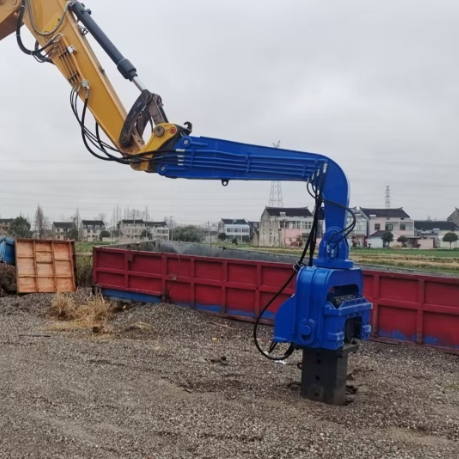
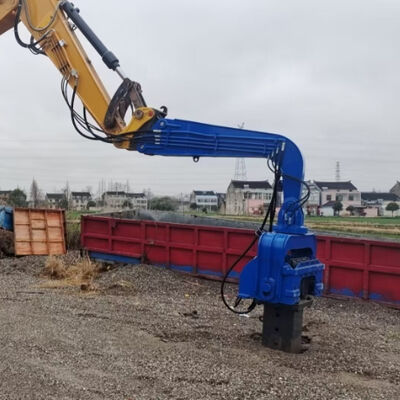
Product Details
| Name | PCF Vibro Hammer/Pile Diver | Feature | Heavy Weight Hammer For Hard Soil Piling |
|---|---|---|---|
| Vibration Frequency | 3500rpm | Operation Pressure | 32Mpa |
| Centrifugal Force | 385KN | Arm | 750kg |
| Hammer | 2950kg | Excavator | 40~45Ton |
| Maximum Piling Depth | 12 Meter | Material | Steel, Core Materials Are All Imported |
| Color | Blue/Yellow/Red/White, Customized Color Available | Type | Hydraulic Vibrating Hammer |
| HS Code | 8430100000 | Condition | New |
| Highlight | hydraulic vibro hammer excavator mounted,vibro pile driver hydraulic,PCF 350 vibro hammer |
||
Product Description
PCF350 Photovoltaic Pile Driver – High-Frequency Piling for Solar Farm Foundations
Overview
The PCF350 is a specialized photovoltaic pile driver engineered exclusively for solar farm foundation construction. As renewable energy projects expand rapidly across Southeast Asia, India, and Russia, the demand for fast, cost-effective, and space-efficient piling solutions has never been greater. The PCF350 mounts directly onto 20-38 ton excavators, transforming them into dedicated pile drivers for precast concrete piles, steel pipe piles, and H-beams used in solar panel support structures. With its two-stage vibration system, dual pump flow merging, and ultra-compact footprint, this machine delivers superior productivity in the tight rows of solar farms – where traditional piling equipment cannot operate.
Key Features & Advantages
1. Photovoltaic Pile Driver – Purpose-Built for Solar Fields
Unlike general-purpose pile drivers that compromise on efficiency, the PCF350 is a true photovoltaic pile driver designed from the ground up for solar applications. Solar farms require hundreds or thousands of piles driven in straight lines with narrow spacing (typically 5-8 meters apart). The PCF350’s narrow profile and excavator mounting allow it to move easily between pile positions without trampling panels or disturbing graded surfaces. The hammer can drive piles up to 3-4 meters deep in loose to medium-dense soils, which are common in solar project sites. For contractors bidding on large-scale solar farms in India’s Rajasthan desert, Russia’s southern steppes, or Southeast Asia’s former agricultural lands, the PCF350 reduces per-pile cost by 30-40% compared to using crane-suspended hammers.
2. Compact Structure Confined Spaces – Maneuverability in Tight Rows
Solar farm layouts are notoriously cramped. The PCF350 features a compact structure confined spaces design, with minimized width and total weight. The hammer body is slim enough to work between already-installed panels, and the excavator’s articulated boom allows precise positioning without swinging into adjacent piles. The total weight of the pile driver (hammer + mounting bracket) is kept low to match 20-38 ton carriers, ensuring the excavator does not become top-heavy when driving piles on uneven ground. This compactness also enables transport on standard flatbed trucks – no oversized permits needed. For remote solar projects in Siberia or Indonesian islands, logistics are simplified, saving weeks of mobilization time.
3. Dual Pump Flow Merging System – Two-Stage Power When Needed
The PCF350 incorporates a dual pump flow merging system that provides two-stage vibration control. Under normal soil conditions, the hammer operates in single-pump mode, conserving fuel and reducing hydraulic heat. When encountering compacted layers, gravel, or clay lenses, the operator engages second-stage vibration, where both excavator pumps merge their flow into the hammer’s hydraulic motor. This instantly boosts centrifugal force, allowing the pile to penetrate hard strata without stalling. The system uses integrated control valves, each action independently controllable for precise modulation. In practice, this means the PCF350 drives piles through mixed soils that would stop lesser hammers – a critical advantage for Russian sites with glacial till or Indian sites with calcareous hardpans.
4. High Frequency Vibration Output – Fast Penetration, Minimal Soil Disturbance
With a vibration frequency range of 2000-2600 rpm, the PCF350 delivers high frequency vibration output that rapidly liquefies granular soils around the pile shaft, drastically reducing friction. High-frequency vibration is particularly effective in sandy and silty soils – exactly the conditions found in many photovoltaic project areas. The pile slides into the ground with less impact stress, preventing concrete pile cracking or steel pile bending. Moreover, high frequency produces lower amplitude, meaning less lateral vibration that could destabilize adjacent recently-driven piles. For solar farms requiring tight pile alignment tolerances (within 20 mm), this precision is invaluable. Field tests show the PCF350 drives a 6-meter precast pile in less than 90 seconds under favorable conditions.
5. Low Maintenance Cost Design – Maximized Uptime for Remote Projects
Solar farms are often built in remote locations where service support is sparse. The PCF350 is built with a low maintenance cost design philosophy. The vibration unit uses German FAG bearings, internationally sourced hydraulic motors (Parker or equivalent), and high-grade seals. The sealed bearing housing requires no daily greasing – only a weekly visual check and oil change every 2000 hours. All wear parts (clamp jaws, hoses, filters) are standard sizes stocked by our regional warehouses in Singapore, Mumbai, and Novosibirsk. The integrated control valve assembly simplifies troubleshooting; any excavator mechanic can read pressure gauges and swap modular cartridges. For contractors operating fleets across multiple solar sites, this translates to lower spare parts inventory, fewer service calls, and higher machine availability.
Technical Specifications (PCF350)
| Parameter | Unit | PCF350 |
|---|---|---|
| Suitable excavator | ton | 20 – 38 |
| Vibration frequency range | rpm | 2000 – 2600 |
| Centrifugal force (single pump) | kN | 450 |
| Centrifugal force (dual pump merged) | kN | 680 |
| Eccentric moment | kg·m | 7.2 |
| Operating pressure | MPa | 32 |
| Operating flow (single/merged) | L/min | 200 – 280 / 280 – 360 |
| Clamping force (standard clamp) | kN | 500 |
| Total weight (hammer + bracket) | kg | 3200 |
| Dimensions (L × W × H) | mm | 1350 × 1150 × 2400 |
| Max pile length (concrete/steel) | m | 8 / 10 |
FAQ – Targeted for Southeast Asia, India, Russia
Q1: Is the PCF350 suitable for rocky or frozen ground (Russia)?
The dual pump flow merging system provides high centrifugal force (up to 680 kN) that can drive piles through dense gravel and weathered rock. For continuous permafrost or solid rock, pre-drilling with an auger is recommended. The high frequency vibration output helps break thin ice layers and frozen crusts down to -15°C.
Q2: How does compact structure confined spaces benefit solar farms with narrow row spacing?
The hammer width is only 1150 mm, and the excavator’s tracks fit within standard 3-4 meter rows. The operator can drive piles without straddling or damaging adjacent panels. No other piling method offers this level of access.
Q3: Can the PCF350 handle different pile types (concrete, steel, H-beam)?
Yes. The clamp system uses interchangeable jaws. Changeover takes 15 minutes. Standard jaws are available for 150-300 mm square concrete piles, 200-400 mm round steel pipes, and H-beams up to 300 mm flange width. For photovoltaic pile driver applications, round steel or square concrete are most common.
Q4: What maintenance does the low maintenance cost design require?
Weekly: check hydraulic oil level and clamp jaw wear. Monthly: grease excavator mounting pins. Every 500 hours: inspect bearings via vibration sensor (optional kit). Every 2000 hours: change bearing oil. No daily greasing. All filters are spin-on type available at any hydraulic supply shop.
Q5: How does the dual pump flow merging system affect fuel consumption?
In single-pump mode (soft soils), fuel consumption is approximately 8-10 L/hour on a 25-ton excavator. When dual pump merging is engaged for hard layers, consumption rises to 14-16 L/hour but only for short bursts. Overall, the PCF350 uses 20-25% less fuel than a crane-suspended vibratory hammer of equivalent power.
Recommended Products
